Honeyfest 2012 at Wyck Historic House and Garden
Last weekend was Philadelphia's third annual Honey Fest! The first one was held one year after beekeeping within Philadelphia was made legal again and was held to promote beekeeping and celebrate Lorenzo Langstroth's 200th birthday. Langstroth, if you were not aware, is the father of modern beekeeping and developer of the first hive to successfully employ bee space with movable frames to make practicle reusable and exchangable hives.
This year's festival took place over three days. The first was was held at the Wagner Free Institute of Science. The second day took place at Wyck Historic House and Garden, and the final day was at Bartram's Garden. I was only able to make it to the second day of activities this year, but it certainly was a fun and busy day. Vendor's, childrens activities, brewing, open hive demonstrations and educational talks were all on the plate for the day. The weather was even kind enough to hold out and provide a beautiful environment for everything, though it did start to pour within a half hour of the festival ending. I gave a honey extraction demonstration to a packed carrige house on the grounds, something I had done last year for Honey Fest at Bartram's Garden. This year I was also lucky enough to give a presentation on the history of beekeeping in Philadelphia with my coworker Sarah Newhouse.
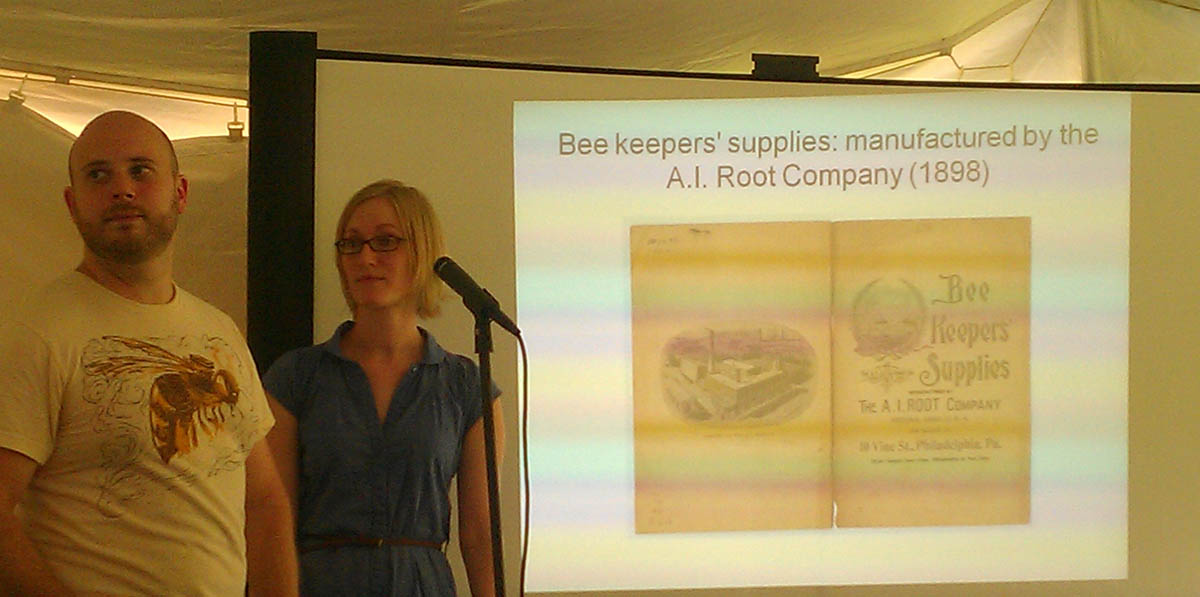
The honeybee we are most familiar with has only been on the east coast of north America since the early 17th century. Philadelphia, as part of the original 13 colonies, was also one of the earliest places to have honeybees. People have been writing about bees and their management methods with them for centuries and the Historical Society of Pennsylvania is lucky enough to hold originals and copies of some early American bee materials dating back as far as the beginning of the 18th century. Sarah and I gave an overview of some of these materials through the centuries along with general coverage of the history of beekeeping up to about 1900. We covered entries from Francis Kelpius Pastorius, the found of Germantown (where Wyck resides) who kept bees and wrote beekeeping, gardening and other tips in monthly guides. It also covered pamphlets several pamphlets from local and semi-local beekeepers and bee enthusiasts sharing their beekeeping tips and their own ideas of bee science of the day. These tips range from rubbing your arms with anise see oil to keep the bees from stinging you to blowing in each hive 3 times between the hour of 11 and midnight on Christmas Even to prevent your hives from swarming in the coming year. One such pamphlet, "The apiarian's guide: being a practical treatise on the culture and management of bees [1849]," provides a reminder that there are always challenges to overcome and likely will be through its discussion of the wax moth and how this pest was seemingly as much of a problem for 19th century beekeepers as the varroa mite is for beekeepers in the 21st century.
There is a lot of good material on this subject and it can certainly be useful to see how we have it made it to where we are today. Many of these advances were made my people who simply enjoyed their bees and wanted to try new things to help them and their bees succeed. They desired to share their findings and advice through information sharing in objects such as pamphlets, and there is no reason we cannot continue to do the same today to tackle these problems through our contemporary equivilant, the Internet.
I hope that next year will go just as well for Honey Fest and that I will be able to participate again. I know that Wyck is planning on holding an amateur mead making competition and I am already getting set to brew a batch to enter!
If you would like to view any of the historic materials on beekeeping Sarah and I used in our presentation you can find digitized copies of most of them freely available at digitallibrary.hsp.org. Here are links to a few of them, though please do search for others:
The apiarian's guide: being a practical treatise on the culture and management of bees [1849]
Bee Culture and In-keeping Tips
Immen Büchlein (The Little Book About Bees), by Johann Grützmann [1669]